
Set 1 MetalVerse Cards
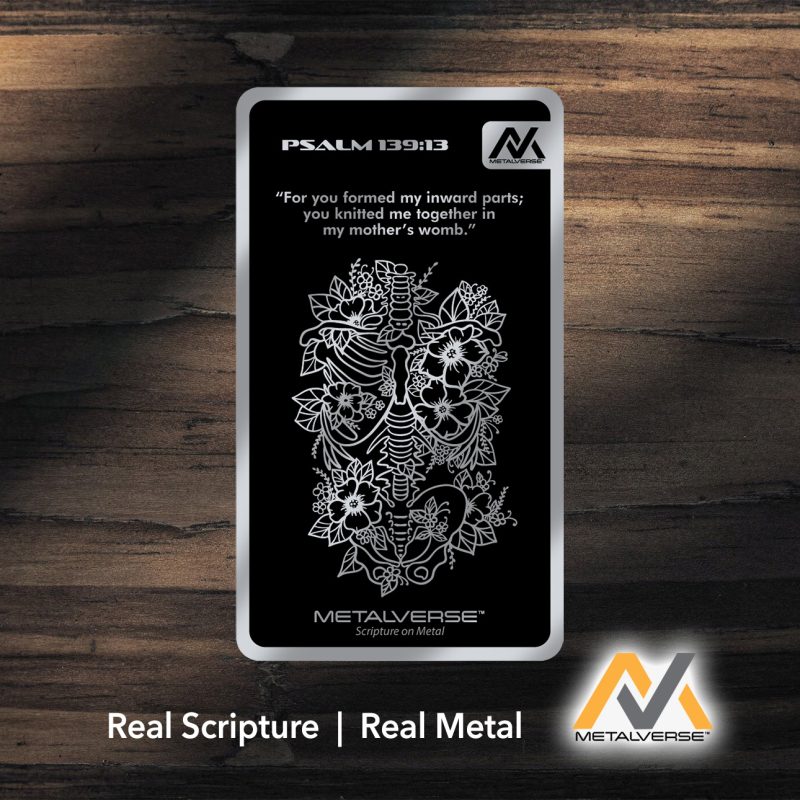
Knitted Together
Jun
Knitted Together – MetalVerse™ Cards
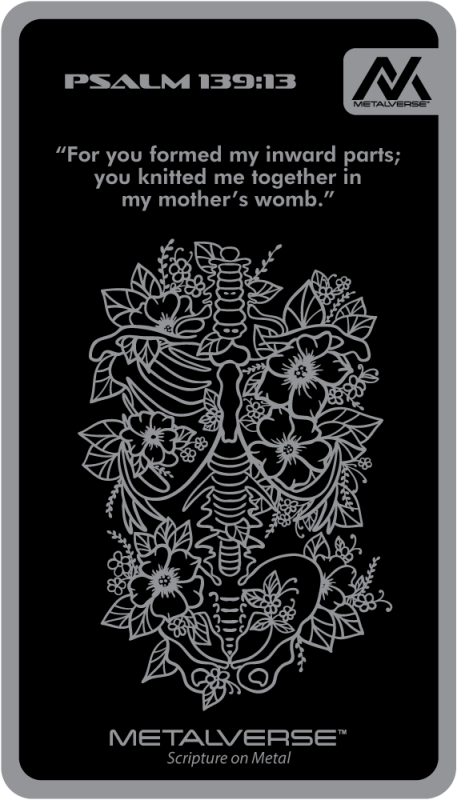
Psalm 139:13
“For YOU formed my inward parts; YOU knitted me together in my mother’s womb.”
An Expository on Psalm 139:13
Key Themes:
1. The Context of Divine Omniscience
Psalm 139 is one of the most breathtaking and deeply personal psalms in all of Scripture. David opens with an overwhelming declaration — “O LORD, thou hast searched me, and known me” (v.1). The entire psalm is a meditation on the absolute, intimate, and all-encompassing knowledge God has of every human being. By the time we reach verse 13, David has already marveled at God’s knowledge of his thoughts, his words, his movements, and his path. Now he dives deeper still — into the very origin of his existence — and discovers that God’s intimate knowledge did not begin at birth. It began before birth, in the hidden, secret place of the womb.
2. “For Thou Hast Possessed My Reins” — God’s Ownership of Our Innermost Being
The word “reins” (kilyah in Hebrew) literally refers to the kidneys — but in ancient Hebrew thought, the kidneys were considered the seat of the deepest emotions, the innermost self, and the most hidden parts of a person’s being. In modern language, we might say — “You have possessed my innermost being,” or “You own the very core of who I am.”
The word “possessed” (qanah) means to create, acquire, and own. This is a declaration of:
- 👑 Divine ownership — God does not merely observe us; He owns us. We are not autonomous beings who happened to come into existence — we are God’s possession, fashioned by His hand for His purposes
- 🏗️ Divine craftsmanship — the word carries the sense of skillful creation. You were not mass-produced or accidentally assembled — you were individually crafted by the Master Creator
- ❤️ Divine intimacy — God’s possession of our innermost being means He knows us at a depth that no human relationship can reach. He knows what we ourselves do not know about ourselves
This truth has profound implications for human identity and dignity. You are not defined by:
- ❌ What others say about you
- ❌ Your past failures or sins
- ❌ Your social status, appearance, or achievements
- ❌ Your own self-perception on your worst day
You are defined by who God says you are — His possession, His creation, His handiwork (Ephesians 2:10).
3. “Thou Hast Covered Me” — The Hiddenness of Divine Creativity
The Hebrew word for “covered” (sakak) is extraordinarily rich in meaning. It carries the sense of weaving together, knitting, intertwining, and sheltering. Some translations render it “knit me together” (ESV) — painting the picture of a master craftsman carefully and deliberately weaving every thread of a person’s being into a magnificent tapestry.
This word reveals several stunning dimensions of God’s creative work:
- 🧶 Intentional design — every detail of your being was purposefully woven by God. Your personality, your temperament, your gifts, your physical features — nothing was accidental or random
- 🛡️ Divine protection — sakak also carries the meaning of sheltering and covering. Even in the hidden vulnerability of the womb, God was not absent — He was actively covering and protecting the developing life
- 🎨 Artistic excellence — the image is of a master weaver at work, not a machine on an assembly line. God brought creative intentionality and artistic care to the making of every human being
- 🔍 Hidden glory — the most magnificent creative work happens in hiddenness. What God weaves in secret, He reveals in due season
4. “In My Mother’s Womb” — The Sanctity of Pre-Born Life
David’s declaration that God was actively at work in the womb carries enormous theological weight. It establishes beyond any doubt that:
- 👶 Life begins at conception — God’s creative, possessing, covering work begins in the womb — not at birth. The pre-born child is not a potential person; they are a person with eternal significance, known and fashioned by God
- 📖 Biblical testimony is consistent — throughout Scripture, God speaks of knowing, calling, and appointing individuals from the womb:
- Jeremiah — “Before I formed thee in the belly I knew thee; and before thou camest forth out of the womb I sanctified thee” (Jeremiah 1:5)
- John the Baptist — “filled with the Holy Ghost, even from his mother’s womb” (Luke 1:15)
- Paul — “separated me from my mother’s womb, and called me by his grace” (Galatians 1:15)
- Isaiah — “The LORD hath called me from the womb” (Isaiah 49:1)
- 🌟 Every life has divine purpose — if God is actively at work before a person takes their first breath, then every human life — regardless of the circumstances of conception — carries inherent dignity, eternal worth, and divine intentionality
5. The Broader Context of Psalm 139:13-16 — The Complete Portrait
Verse 13 is the gateway into one of the most remarkable passages on human origins in all of Scripture. The surrounding verses complete the magnificent portrait:
- 🙏 “I will praise thee; for I am fearfully and wonderfully made” (v.14) — David’s response to the revelation of verse 13 is worship. The correct response to understanding how God made us is not pride — it is awe and adoration.
- 🦴 “My substance was not hid from thee, when I was made in secret, and curiously wrought in the lowest parts of the earth” (v.15) — the phrase “curiously wrought” means embroidered — another textile image of intricate, detailed, artistic craftsmanship. Even the hidden formation of bones, organs, and systems was fully visible to God.
- 📖 “Thine eyes did see my substance, yet being unperfect; and in thy book all my members were written, which in continuance were fashioned, when as yet there was none of them” (v.16) — before a single cell divided, before a single feature formed, God had already written the complete story of this person’s life. You were in God’s book before you were in your mother’s womb.
6. “Fearfully and Wonderfully Made” — The Theology of Human Dignity
Though verse 14 extends beyond our text, it cannot be separated from verse 13. The word “fearfully” (yare) means with awe-inspiring, reverential wonder. The word “wonderfully” (pala) means set apart, distinguished, extraordinary. Together they declare:
- Every human being is an awe-inspiring work of divine art
- Every person is set apart and distinguished from all other creation
- The human body and soul together constitute the most complex and magnificent creative work in the known universe
- To despise yourself is to critique the workmanship of God
7. Implications for the Struggling Believer
This verse speaks with particular power to those who struggle with:
- 💔 Self-rejection and self-hatred — God possessed and crafted you with intentional care. You are not a mistake.
- 😢 Identity crisis — your deepest identity is not constructed by culture, trauma, or opinion — it is woven by God before you drew your first breath.
- 🌑 Depression and worthlessness — the God who spoke galaxies into existence considered you worth His most careful, intimate creative attention.
- ❓ Questions about purpose — if God was at work before your birth, He had purpose in mind before your beginning. Your life is not an accident waiting to be explained — it is a divine intention waiting to be unfolded.
The Three Revelations of Psalm 139:13:
| Truth | Hebrew Word | What It Reveals |
|---|---|---|
| 👑 God Owns Us | Qanah — possessed/created | We are His craftsmanship, not accidents |
| 🧶 God Wove Us | Sakak — covered/knit | We are intentionally and artistically made |
| 🏠 God Was There | Beten — womb | Life and dignity begin before birth |
New Testament Fulfillment:
The truth of Psalm 139:13 reaches its fullest glory in the New Covenant:
- 🕊️ We are “created in Christ Jesus unto good works, which God hath before ordained” (Ephesians 2:10) — the same intentionality seen in the womb extends to eternal purpose in Christ
- 👑 “Before the foundation of the world” God chose us (Ephesians 1:4) — His knowledge and purpose for us extends not merely to the womb, but to eternity past
- ❤️ “I have called thee by thy name; thou art mine” (Isaiah 43:1) — the God who wove you knows your name and claims you as His own
A Word of Personal Application:
In a world that assigns worth based on performance, appearance, productivity, and social approval — Psalm 139:13 declares a radically different value system. Your worth was not earned — it was woven in. Before you achieved anything. Before you failed anything. Before anyone knew your name. God possessed you, crafted you, and covered you with the same hands that fashioned the stars.
You are not:
- 🚫 A biological accident
- 🚫 A product of chance
- 🚫 Defined by your worst moment
- 🚫 Worthless, forgotten, or overlooked
You are:
- ✅ Personally crafted by the Creator of the universe
- ✅ Possessed and owned by the God of all eternity
- ✅ Covered and protected from your very first moment of existence
- ✅ Written in God’s book before the world began
- ✅ “Fearfully and wonderfully made” — set apart and extraordinary by divine design
The Call: Receive the truth of how God made you — and worship. That is David’s response in verse 14, and it is the only fitting response to the staggering reality of Psalm 139:13. You are not an accident. You are not forgotten. You are not worthless. You are the intentional, intimate, and extraordinary handiwork of Almighty God — possessed, woven, and covered by the One who knows you better than you know yourself, and loves you still. Walk today in the dignity of who He made you to be.
🌐 Sources
- biblegateway.com – Psalm 139:13
- gotquestions.org – Psalm 139:13-16 Meaning
- preceptaustin.org – Psalm 139 Commentary
- blueletterbible.org – Psalm 139:13
- desiringgod.org – Fearfully and Wonderfully Made
- crosswalk.com – Psalm 139:13 Meaning and Commentary
- thegospelcoalition.org – You Are Fearfully and Wonderfully Made
Don’t have this MetalVerse™ Scripture Card yet?
ORDER HEREYOU CAN DOWNLOAD THE PDF STUDY GUIDE HERE:
DOWNLOAD GUIDE