Set 1 MetalVerse Cards
Refuge
Jun
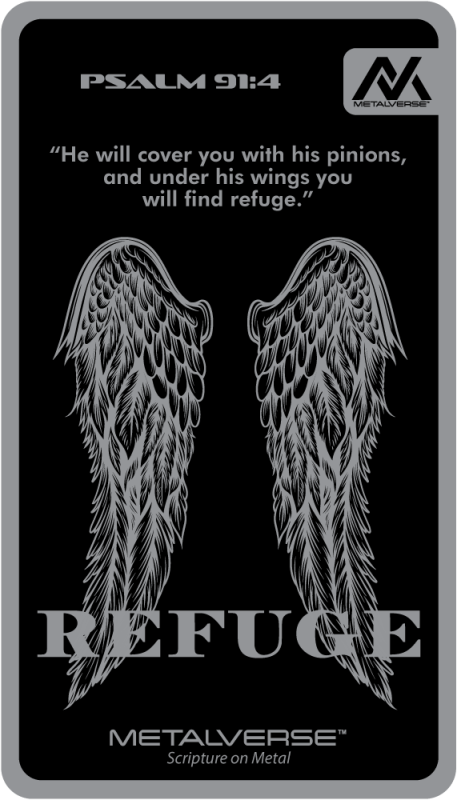
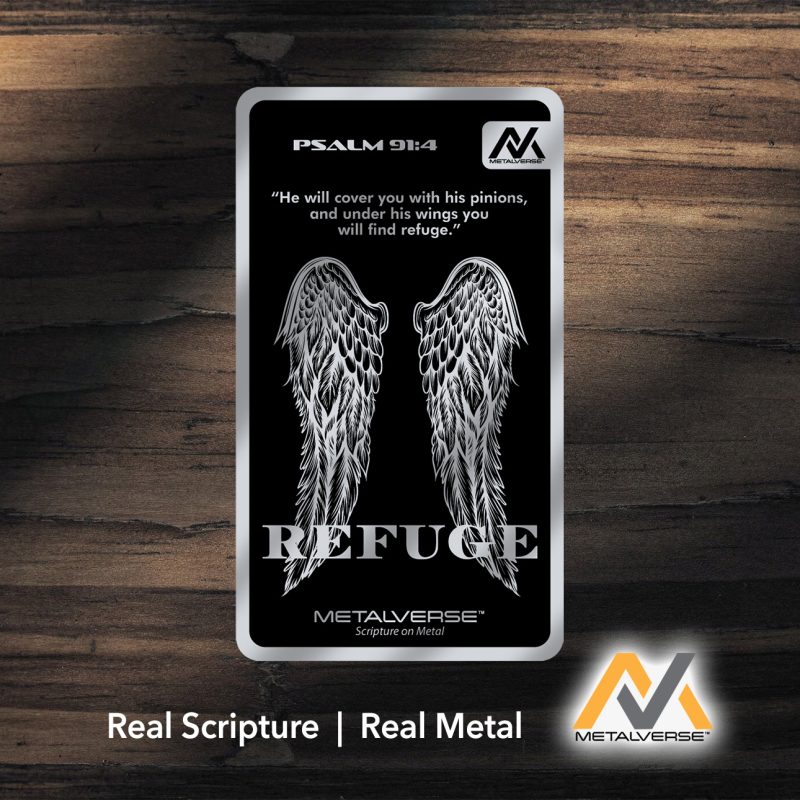
Refuge – MetalVerse™ Cards
Psalm 91:4
“HE will cover you with his pinions, and under HIS wings you will find refuge.”
An Exposition of Psalm 91:4
Key Themes:
1. The Context of the Shelter Psalm
Psalm 91 stands as one of the most magnificent and beloved protection psalms in all of Scripture. It has been called the “Soldier’s Psalm,” the “Traveler’s Psalm,” and the “Plague Psalm” — because across centuries of human history, God’s people have turned to its promises in every conceivable season of danger, uncertainty, and mortal threat. From soldiers carrying it into battle to believers reciting it in seasons of pestilence and persecution, Psalm 91 has been the refuge of the faithful across every generation.
The psalm opens with one of the most foundational declarations in all of Scripture — “He that dwelleth in the secret place of the most High shall abide under the shadow of the Almighty” (v.1). The essential condition of all that follows is established immediately — the promises of Psalm 91 are not universal guarantees for all humanity; they are the specific inheritance of those who dwell in the secret place — those who have chosen the presence of God as their primary home and habitation.
By the time we reach verse 4, the psalmist has already declared:
- 🏰 God as “my refuge and my fortress” (v.2) — the architectural language of impenetrable protection
- 🦅 Deliverance “from the snare of the fowler, and from the noisome pestilence” (v.3) — protection from both cunning traps and deadly diseases
Verse 4 now introduces the most tender and intimate imagery in the entire psalm — moving from the military language of fortresses and snares to the maternal language of feathers and wings. The God who is a mighty fortress is also a sheltering mother — and it is in this stunning combination of power and tenderness that the fullness of divine protection is revealed.
2. The Identity of the Psalmist
While the authorship of Psalm 91 is debated — with Moses being the most frequently proposed author, supported by its position immediately following the prayer of Moses in Psalm 90 — what is undeniable is that this psalm was written by someone who had experienced the personal, intimate, and experiential reality of divine protection. This is not theological theory — it is testimony. Every image in verse 4 has been inhabited before it was written.
The great theologian Charles Spurgeon wrote of this psalm that it “is one of the most excellent” of all the songs of Zion — noting that it moves through a progression of protection from the general to the intensely specific, from the architectural to the biological, from the cosmic to the personal. Verse 4 represents the most personal and intimate point of that progression.
3. “He Shall Cover Thee With His Feathers” — The Intimacy of Divine Protection
The opening image of verse 4 is one of the most tenderly beautiful in all of sacred literature. The Almighty God — the One who “measured the waters in the hollow of his hand, and meted out heaven with the span” (Isaiah 40:12) — is portrayed as a mother bird spreading her feathers over her vulnerable, trembling young.
The Imagery in Its Ancient Context:
In the ancient Near Eastern world, the image of a divine bird with sheltering wings was a well-known symbol of protection and royal care. But the Hebrew poets and prophets took this image and transformed it — filling it with the specific, personal, covenant love of the God of Israel — the God who is not merely powerful but personally invested in the protection of those who trust Him.
The specific image most naturally evoked is that of a mother hen with her chicks — an image Jesus Himself would use with heartbreaking beauty: “O Jerusalem, Jerusalem…how often would I have gathered thy children together, even as a hen gathereth her chickens under her wings, and ye would not!” (Matthew 23:37). The connection between Psalm 91:4 and Matthew 23:37 is not accidental — Jesus is deliberately evoking the tender, maternal, sheltering love of God that the psalm had promised centuries earlier.
What the Feathers Represent:
Tenderness and Warmth:
- 🕊️ Feathers are soft, warm, and gentle — the protection God provides is not cold or clinical; it is warm, personal, and tender
- Unlike the hard stone of a fortress wall, feathers represent protection that envelops and embraces — God’s covering is an act of intimate love, not merely efficient defense
- The warmth of a mother bird’s feathers under which her chicks shelter represents the warmth of God’s love in which the trusting believer finds their deepest security
Completeness of Coverage:
- A mother bird’s feathers, spread over her young, cover completely — leaving no chick exposed, no vulnerability unaddressed
- The Hebrew word for “cover” (sakak) speaks of spreading over, weaving together, and completely canopying — there is no partial coverage in this image. God does not leave gaps in His protection
- Sakak is also the word used for the wings of the cherubim that overshadowed the mercy seat in the Holy of Holies (Exodus 25:20) — connecting the divine covering of Psalm 91:4 to the most sacred symbol of God’s presence in all of Israel’s worship
Hiddenness and Concealment:
- Under a mother bird’s feathers, a chick is completely hidden from predators — invisible to every threat
- This connects beautifully to verse 1 — the “secret place” of the Most High. The Hebrew seter (secret place) speaks of concealment — being hidden from view in God’s presence
- The Apostle Paul echoes this imagery in his declaration — “your life is hid with Christ in God” (Colossians 3:3). The most secure hiding place in all of existence is within God Himself
Proximity and Closeness:
- To be under the feathers is to be close — as close as possible. This is not distant protection from afar; it is intimate protection from within
- The God who covers us with His feathers is the God who is “a very present help in trouble” (Psalm 46:1) — present in the most literal and immediate sense
- There is no safer place in all of creation than under the feathers of the Almighty — and there is no closer place to God than there
4. “And Under His Wings Shalt Thou Trust” — The Posture of Holy Trust
Having declared the divine action — “He shall cover thee” — the psalmist now describes the human response — “under his wings shalt thou trust.” The covering is God’s initiative; the trusting is the believer’s joyful, voluntary response.
The Hebrew Word for “Trust” — Chasah:
The word translated “trust” is the Hebrew chasah — and it is one of the richest and most expressive words in the entire Hebrew vocabulary of faith. It means:
- 🏃 To flee for refuge — the image is of someone running from danger and finding shelter in a place of safety
- 🤗 To take refuge in, to confide in — a conscious, deliberate choice to place oneself under the protection of another
- 🔐 To hope in, to be secure in — not a trembling, fearful hope but a confident, secure expectation based on the character and faithfulness of the One trusted
The word chasah appears frequently in the Psalms as the standard description of the fundamental posture of the believing soul before God:
- “O my God, I trust in thee” (Psalm 25:2)
- “Blessed are all they that put their trust in him” (Psalm 2:12)
- “How excellent is thy lovingkindness, O God! therefore the children of men put their trust under the shadow of thy wings” (Psalm 36:7)
The image of trust in chasah is not passive — it is the image of a small, vulnerable creature deliberately running toward a place of protection and nestling there in confident security. The chick does not stumble accidentally under the mother’s wings — it runs there with intentional, eager trust, knowing that those wings represent absolute safety.
Trust as Active, Not Passive:
Many believers misunderstand biblical trust as a kind of spiritual passivity — a resigned waiting for God to act. But chasah is anything but passive. It describes:
- 🏃 Running to God — actively, urgently, deliberately seeking the shelter He provides
- 🙏 Choosing God over every other source of security — refusing the temptation to trust in “chariots” or “horses” (Psalm 20:7), in human wisdom or human strength
- 🔒 Resting in God — having run to Him, settling into His shelter with calm, confident security rather than anxious fretting
- 💎 Persisting in trust — maintaining the posture of trust even when circumstances argue against it, even when the heat of trial increases, even when the mother bird’s feathers seem insufficient against the storm
Trust Under the Wings — Not Instead of the Wings:
The psalmist is specific — trust is exercised “under his wings” — not at a distance, not theoretically, not in the abstract. Trust is positional — it is the posture of one who has actually gotten under the wings, actually entered the secret place, actually taken up residence in the shelter of the Almighty.
Many believers know about God’s wings without actually getting under them — they affirm the doctrine of divine protection while living in practical anxiety and self-reliance. The psalmist calls the believer to a trust that is not merely intellectual but experiential and positional — a trust that has actually moved into the shelter and found it to be everything God promised.
5. “His Truth Shall Be Thy Shield” — The First Weapon of Divine Protection
The imagery now shifts dramatically — from the organic warmth of feathers and wings to the military strength of armor and weaponry. This shift is itself theologically significant — it reveals that God’s protection is both tender and powerful, both intimate and invincible, both as gentle as a mother bird and as formidable as a Roman legion.
The first instrument of divine protection named is truth — “his truth shall be thy shield.”
What Is “His Truth”?
The Hebrew word for “truth” here is emet — one of the most comprehensive and theologically rich words in the Hebrew Bible. It speaks of:
- 📜 Faithfulness and reliability — God’s absolute trustworthiness, His unwavering commitment to keep every promise He has ever made
- 🏗️ Firmness and stability — emet comes from the root aman (from which we get “Amen”) — meaning to be established, confirmed, and absolutely reliable
- 💡 Truth as revealed reality — God’s Word as the true account of all of reality — what is genuinely real as opposed to the enemy’s counterfeit version of reality
- 🤝 Covenant loyalty — God’s emet is His absolute faithfulness to His covenant relationship with His people — “Great is thy faithfulness” (Lamentations 3:23)
The Shield — Tsinnah:
The word translated “shield” is tsinnah — a large, body-length shield that provided comprehensive protection for the entire body of a soldier. Unlike a smaller buckler used for quick deflection of specific blows, the tsinnah was the primary defensive weapon that a soldier carried into battle — large enough to shelter completely behind in the fiercest moments of combat.
That God’s truth is this comprehensive shield reveals several profound realities:
Truth as Protection Against Deception:
- The enemy’s primary weapon is lies — “he is a liar, and the father of it” (John 8:44). His first assault in the Garden was not physical force but deceptive speech — “Yea, hath God said?” (Genesis 3:1)
- God’s truth — His Word, His faithful character, His unfailing promises — is the comprehensive shield that deflects every arrow of deception the enemy fires
- When the enemy says “God has abandoned you” — the shield of truth declares “I will never leave thee, nor forsake thee” (Hebrews 13:5)
- When the enemy says “You are beyond redemption” — the shield of truth declares “the blood of Jesus Christ his Son cleanseth us from all sin” (1 John 1:7)
- When the enemy says “Your situation is hopeless” — the shield of truth declares “with God all things are possible” (Matthew 19:26)
Truth as Protection Against Doubt:
- In seasons of severe trial, when God seems silent and circumstances seem to argue against His goodness, the shield of truth holds not because we feel it but because it is true
- Faith under fire is the decision to trust what God has said over what circumstances seem to say — to hold the shield of truth even when every emotion argues for putting it down
- The shield works whether we feel it working or not — its effectiveness depends not on our feelings but on the faithfulness of the One whose truth it is
Truth as Protection Against the Accuser:
- Revelation 12:10 describes Satan as “the accuser of our brethren” — one who stands before God and rehearses the failures, sins, and inadequacies of believers in an attempt to disqualify them from God’s protection and promises
- The shield of God’s truth declares: “There is therefore now no condemnation to them which are in Christ Jesus” (Romans 8:1) — the accuser’s case has been permanently dismissed by the blood of Christ
- “Who shall lay any thing to the charge of God’s elect? It is God that justifieth” (Romans 8:33) — the shield of divine truth silences every accusation
6. “And Buckler” — The Second Weapon of Complete Protection
The verse concludes with the addition of a second defensive weapon — the “buckler.” The Hebrew word is socherah — a smaller, round shield held in the hand and used in close combat to deflect specific, targeted blows.
The Significance of Two Shields:
The pairing of tsinnah (large shield) and socherah (buckler) is militarily comprehensive — together they represent protection at every range of combat:
- 🛡️ The large shield (tsinnah) provides comprehensive protection at a distance — sheltering the entire body from incoming arrows and projectiles
- 🛡️ The buckler (socherah) provides targeted protection in close quarters — deflecting the specific, close-range strikes of hand-to-hand combat
The theological implication is profound — God’s truth protects the believer from every category of enemy attack:
- ⬅️ Distant attacks — the long-range assaults of deception, accusation, and doubt that come from afar
- ➡️ Close-range attacks — the intimate, personal, targeted assaults on specific weaknesses, specific fears, and specific vulnerabilities
Surrounding Protection:
Some Hebrew scholars note that the pairing of tsinnah and socherah in this context suggests all-surrounding, comprehensive protection — front, back, left, right, top, bottom. God’s truth is not a shield that protects from one direction while leaving another angle exposed — it is a complete, omnidirectional defensive system that covers every angle of attack.
This connects beautifully to the broader theme of Psalm 91 — which describes protection from every conceivable category of threat:
- 🐦 The fowler’s snare — cunning, hidden traps (v.3)
- 🦠 The noisome pestilence — deadly disease (v.3)
- 🌃 The terror by night — nocturnal fears and hidden dangers (v.5)
- 🏹 The arrow by day — visible, direct attacks (v.5)
- ☁️ The pestilence that walketh in darkness — unseen forces of destruction (v.6)
- ☀️ The destruction that wasteth at noonday — open, brazen assaults (v.6)
- 🐍 Serpents and scorpions — dangerous, venomous enemies (v.13)
Against each and every one of these — the truth of God stands as both tsinnah and socherah — comprehensive and complete in its protection.
7. The Progression of Verse 4 — From Tenderness to Strength
One of the most theologically beautiful features of Psalm 91:4 is its internal progression — moving from the most tender and intimate imagery to the most militarily powerful:
| Image | Character of God Revealed | Type of Protection |
|---|---|---|
| 🐦 Feathers | Maternal tenderness and love | Warm, personal, enveloping |
| 🦅 Wings | Sheltering, hovering presence | Comprehensive, intimate covering |
| 🛡️ Shield (tsinnah) | Mighty Warrior and Defender | Comprehensive long-range protection |
| ⚔️ Buckler (socherah) | Close-combat Champion | Targeted, close-range protection |
This progression is intentionally designed to reveal that the God of Psalm 91 is not merely one or the other — not merely tender or powerful, not merely loving or invincible. He is both simultaneously and completely:
- 💗 As tender as a mother bird nestling her chicks under her feathers
- 💪 As invincible as a warrior whose truth-shield deflects every weapon the enemy possesses
The God who covers you with His feathers is the same God whose truth is your shield. The One whose wings shelter you in warmth and intimacy is the same One whose buckler stands between you and every close-range assault of the enemy. There is no tension between these images — they are complementary revelations of the multi-dimensional perfection of divine protection.
8. The Connection to Psalm 91 as a Whole
Verse 4 does not stand alone — it is the intimate heart of a comprehensive protection psalm that builds from beginning to end:
- v.1-2 — The foundation: dwelling in the secret place, making God your refuge
- v.3 — The first promises: deliverance from snares and pestilence
- v.4 — The heart: the intimate, tender, powerful nature of divine covering
- v.5-8 — The scope: protection from every category of threat — day and night, seen and unseen
- v.9-10 — The condition reaffirmed: “Because thou hast made the LORD…thy habitation”
- v.11-13 — The angelic dimension: “He shall give his angels charge over thee”
- v.14-16 — The divine testimony: God Himself speaks and confirms every promise with His own voice
Verse 4 is the theological center of gravity of the entire psalm — the verse that reveals why all the other promises are true. The promises of angels (v.11), of victory over lions and serpents (v.13), of long life and salvation (v.16) — all flow from the foundational reality of verse 4: God Himself covers His own.
9. The New Testament Fulfillment
Psalm 91:4 finds its ultimate and most glorious fulfillment in the person and work of Jesus Christ:
Jesus as the Perfect Expression of Divine Covering:
- 🕊️ “The Word was made flesh, and dwelt among us” (John 1:14) — the eternal God spreading His feathers over humanity by taking on human flesh and entering our condition
- ✝️ “He hath made him to be sin for us, who knew no sin” (2 Corinthians 5:21) — Jesus as the ultimate covering, bearing the full weight of human sin and shame
- 🌅 “Who his own self bare our sins in his own body on the tree…by whose stripes ye were healed” (1 Peter 2:24) — the wings of divine covering spread to their fullest extent on the cross
The Holy Spirit as the Indwelling Covering:
- 🕊️ “Your body is the temple of the Holy Ghost which is in you” (1 Corinthians 6:19) — the ultimate expression of divine covering — God dwelling not merely over us but within us
- 🔥 “The Spirit itself maketh intercession for us” (Romans 8:26) — the covering of prayer on our behalf from within
- 💪 “Greater is he that is in you, than he that is in the world” (1 John 4:4) — the covering that exceeds every opposing power
Satan’s Misuse of This Verse:
It is significant that when Satan tempted Jesus in the wilderness, he quoted Psalm 91:11-12 — “He shall give his angels charge over thee” — attempting to manipulate the promise of divine protection into a presumptuous test of God (Matthew 4:6). Jesus’ response reveals the proper relationship to promises of divine protection: they are to be trusted and inhabited, not tested and manipulated. The believer who genuinely lives under the wings of God (v.4) does not need to prove the protection — they experience it.
10. The Shepherd’s Psalm and the Shelter Psalm Together
Psalm 91:4 is best understood alongside its great companion passage — Psalm 23. Together these two psalms form the most complete portrait of divine care in all of Scripture:
- Psalm 23 — “The LORD is my shepherd” — God as the caring shepherd who provides, guides, restores, and accompanies His flock through every valley
- Psalm 91 — “He shall cover thee with his feathers” — God as the protecting eagle and warrior who shelters, defends, and delivers His own from every threat
The shepherd lies down in the gate of the sheepfold at night to protect the flock — his own body becomes the door. The mother eagle spreads her wings over her young — her own body becomes the shield. In both images, God’s protection is not remote or mechanical — it is profoundly personal, involving the very person of God as the means of protection.
A Complete Portrait of Psalm 91:4:
| Element | Hebrew | Theological Meaning |
|---|---|---|
| 🐦 Cover with feathers | Sakak | Complete canopy of divine love and warmth |
| 🦅 Under His wings | Kanaph | Sheltering, hovering, protecting presence |
| 🙏 Shalt thou trust | Chasah | Active flight to God as refuge and security |
| 🛡️ Shield | Tsinnah | Comprehensive long-range protection by divine truth |
| ⚔️ Buckler | Socherah | Close-range, targeted protection by divine truth |
| 📜 His truth | Emet | God’s faithfulness, His Word, His covenant loyalty |
A Word of Personal Application:
Psalm 91:4 speaks with particular power to several categories of human experience:
For the Anxious:
The feathers and wings of God are the answer to anxiety — not positive thinking, not medication, not distraction (though these may have their proper place) — but the genuine, experienced reality of sheltering under God’s wings. “Be careful for nothing; but in every thing by prayer and supplication with thanksgiving let your requests be made known unto God. And the peace of God, which passeth all understanding, shall keep your hearts and minds through Christ Jesus” (Philippians 4:6-7).
For the Attacked:
The shield and buckler of God’s truth are the answer to every spiritual, emotional, and relational attack. When the enemy comes with his accusations, his deceptions, his temptations, and his discouragements — raise the shield. Open the Word. Declare the truth. Stand behind the tsinnah of God’s faithfulness and the socherah of His specific promises to you.
For the Weary:
The image of nestling under God’s feathers is an invitation to rest — to stop striving, stop performing, stop trying to secure yourself through your own effort — and simply get under the wings. Rest is not laziness — it is the supreme act of trust. The chick that rests under its mother’s feathers is demonstrating complete confidence in her protection. To rest in God is to declare — “You are enough. Your covering is sufficient. I trust You completely.”
For the Fearful:
Whatever you fear — whether the “terror by night” or the “arrow that flieth by day”, whether the hidden danger or the open assault — the promise of verse 4 is that God’s covering is greater than your fear. You are not facing your situation with the resources of your own courage, wisdom, or strength — you are facing it under the feathers of the Almighty, behind the shield of the God whose truth never fails.
The Call: Run to the wings. Take refuge under the feathers. Raise the shield of His truth. And rest — fully, completely, confidently — in the comprehensive, tender, invincible protection of the God who covers you. The mother hen does not merely offer her wings — she spreads them wide and calls her chicks to shelter. The call of Psalm 91:4 is the call of God Himself — “Come. Hide here. Trust here. Rest here. You are covered.”
And in the words of the greater Psalmist — Jesus Christ, the Son of God — who longed to gather Jerusalem “as a hen gathereth her chickens under her wings” — that same longing, that same love, that same spreading of protective wings is extended to every trembling, weary, attacked, and anxious soul who will simply respond to the invitation and get under the wings.
🌐 Sources
- biblegateway.com – Psalm 91:4
- gotquestions.org – Psalm 91 Meaning and Commentary
- preceptaustin.org – Psalm 91:4 Commentary
- blueletterbible.org – Psalm 91:4
- desiringgod.org – God Our Refuge and Fortress
- crosswalk.com – Psalm 91:4 Meaning and Commentary
- thegospelcoalition.org – The Shelter of God’s Wings
- biblehub.com – Psalm 91:4 Commentaries