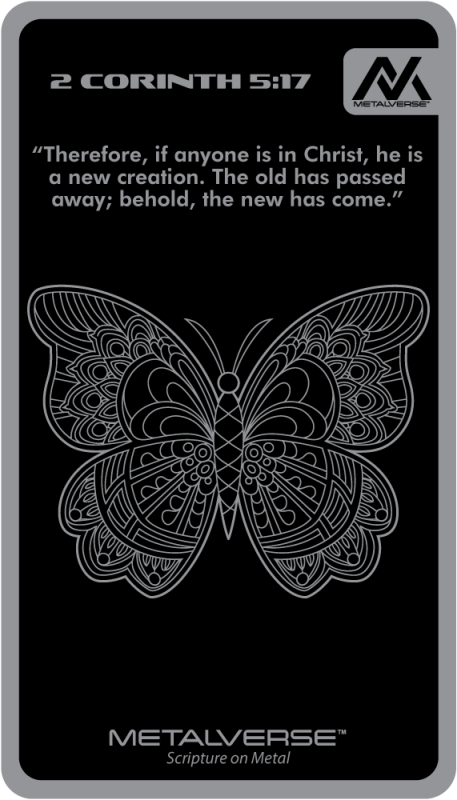
Set 1 MetalVerse Cards
New Creation
Jun
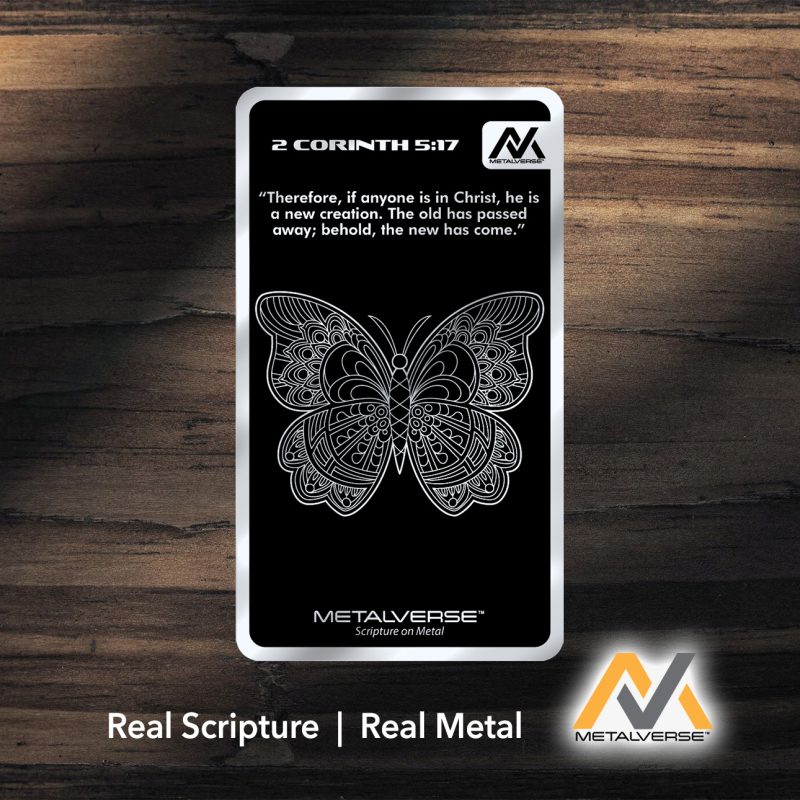
New Creation – MetalVerse™ Cards
2 Corinthians 5:17
“Therefore, if anyone is in Christ, he is a new creation. The old has passed away; behold, the new has come.”
An Exposition of 2 Corinthians 5:17
Key Themes:
1. The Context of Resurrection Living
2 Corinthians is perhaps the most personally transparent of all Paul’s letters. Unlike the theological architecture of Romans or the doctrinal precision of Ephesians, 2 Corinthians is a letter written from the depths of a wounded and wondering heart — a heart that has suffered shipwreck, imprisonment, beatings, betrayal, and relentless opposition, yet refuses to be extinguished. Paul writes to a church that has questioned his apostleship, doubted his sincerity, and flirted with false teachers — and yet he writes not with bitterness but with the blazing conviction of a man who has encountered the transforming power of the risen Christ.
By the time we reach chapter 5, Paul has been building toward one of the most theologically explosive declarations in all of his writings. He has spoken of:
- 🏛️ The earthly tent vs. the heavenly building (v.1) — our temporary bodies vs. our eternal resurrection bodies
- 🙏 The groaning and longing of the believer for ultimate redemption (v.2-4)
- 🕊️ The earnest of the Spirit — the down payment of divine life already deposited within us (v.5)
- 🚶 Walking by faith, not by sight (v.7) — the fundamental orientation of the new creation life
- 👑 The judgment seat of Christ (v.10) — the accounting every believer will give for their stewardship of new creation life
- ❤️ The constraining love of Christ (v.14) — “the love of Christ constraineth us” — the motivating force behind all gospel ministry
- ✝️ The revolutionary reorientation of perspective (v.16) — “Wherefore henceforth know we no man after the flesh” — the new creation way of seeing all of reality
It is from this magnificent theological runway that verse 17 launches into one of the most breathtaking declarations of divine transformation ever committed to human language. This is not merely a verse to memorize — it is a reality to inhabit, a truth to stand upon, a declaration to live from every single day of the Christian life.
2. “Therefore” — The Logical Hinge of Transformation
The verse opens with the word “Therefore” — and like all great theological “therefores” in Scripture, it demands that we ask — “therefore what?” What has Paul established that makes verse 17 the necessary, logical, and inevitable conclusion?
The “therefore” connects verse 17 to the revolutionary declaration of verse 15 — “And that he died for all, that they which live should not henceforth live unto themselves, but unto him which died for them, and rose again.” The logic is airtight:
- ✝️ Christ died for all — the substitutionary death of Jesus Christ on behalf of every human being
- 🌅 Christ rose again — the resurrection that validated His sacrifice and inaugurated the new creation age
- 🔄 Therefore — those who are united to the dead and risen Christ share in both His death and His resurrection — they are new creatures
The “therefore” also connects to verse 16 — the declaration that believers no longer know anyone “after the flesh.” If the old way of evaluating reality — by external, fleshly, worldly standards — is gone, then verse 17 explains why: the entire order of the old creation has passed away for those who are in Christ, and an entirely new order of reality has come into being.
3. “If Any Man Be In Christ” — The Condition and the Location
The opening condition of verse 17 is simultaneously the most inclusive and the most specific statement possible — “if any man be in Christ.”
The Radical Inclusivity of “Any Man”:
- 👤 No one is excluded from the possibility of becoming a new creation
- 🌍 No nationality, ethnicity, social class, gender, age, or background disqualifies any human being from this transforming reality
- 💔 No past — however dark, however destructive, however seemingly irredeemable — places anyone beyond the reach of this promise
- 🔓 “Any man” reaches the murderer on death row, the addict in the gutter, the religious hypocrite in the pew, the moral failure hiding behind respectability — anyone who is in Christ is a new creation
The Profound Specificity of “In Christ”:
The phrase “in Christ” is perhaps the most theologically loaded expression in all of Paul’s writings. It appears over 160 times in his letters — making it one of the most frequently repeated concepts in the entire New Testament. To be “in Christ” means:
- 🌳 Vital union — not merely a religious association or a formal affiliation, but an organic, living union as intimate as a branch connected to a vine (John 15:5) or a body connected to its head (Ephesians 1:22-23)
- ⚖️ Legal standing — to be “in Christ” is to be positionally identified with Him in everything He has accomplished. His death becomes your death (Romans 6:3). His resurrection becomes your resurrection (Romans 6:5). His righteousness becomes your righteousness (2 Corinthians 5:21). His acceptance before the Father becomes your acceptance (Ephesians 1:6)
- 🏠 Indwelling reality — “Christ in you, the hope of glory” (Colossians 1:27). The relationship is mutual — you are in Christ and Christ is in you — a reciprocal union of breathtaking intimacy
- 🔐 Eternal security — “your life is hid with Christ in God” (Colossians 3:3). To be in Christ is to be placed in the most secure location in all of existence — hidden within the very life of God Himself
- 🌟 New identity — before Christ, a person’s identity is shaped by their past, their performance, their failures, and the opinions of others. In Christ, identity is defined by who God says you are — beloved, chosen, holy, blameless, and accepted (Ephesians 1:4-6)
The conditional “if” is not expressing doubt — it is identifying the essential prerequisite. The new creation is not a universal reality for every human being — it is the specific, exclusive, glorious reality of those who have been united to Christ by faith. The “if” is an invitation: Come into Christ, and receive what only Christ can give.
4. “He Is A New Creature” — The Revolutionary Declaration
This is the ground zero of the entire verse — the declaration that detonates every human assumption about identity, possibility, and transformation. “He is a new creature” — present tense, current reality, already accomplished.
The Greek: Kainē Ktisis
The two Greek words that form this phrase carry enormous theological weight:
Kainē — New:
There are two Greek words commonly translated “new”:
- Neos — new in time — something that has recently come into existence, a newer version of the same thing
- Kainos — new in kind and quality — something that is unprecedented, of a completely different nature, without antecedent or parallel
Paul uses kainē — new in kind. This is not a renovated old creature. This is not a refurbished version of the previous self. This is not a 2.0 upgrade of the original model. This is something entirely and categorically different — a new kind of humanity that did not previously exist.
This is the same word used in:
- 🌟 “A new commandment I give unto you” (John 13:34) — not a revision of the old, but something qualitatively unprecedented
- 🌟 “And he that sat upon the throne said, Behold, I make all things new” (Revelation 21:5) — the new creation of the age to come, of which the believer is already a first fruit (James 1:18)
- 🌟 “This cup is the new testament in my blood” (Luke 22:20) — the new covenant — not a renegotiation of the old, but an entirely new arrangement between God and humanity
Ktisis — Creature/Creation:
This word (ktisis) is the standard word for creation — the act of bringing something into existence from nothing, or bringing into existence something that is qualitatively unprecedented. It is the language of Genesis 1 — “In the beginning God created” — the ex nihilo creative power of God bringing into being what did not previously exist.
When Paul says the believer is a kainē ktisis, he is using creation language — the same category of divine action as the original creation of the universe — to describe what happens to a human being who comes into union with Christ. The new birth is not merely moral improvement or spiritual awakening — it is a creative act of God that brings into existence a new kind of person who did not previously exist.
The Staggering Implications:
- 🔨 God did not merely repair you — He re-created you
- 🎨 God did not merely touch up the old painting — He created an entirely new canvas
- 🏗️ God did not merely renovate the old structure — He tore it down and built something new from the ground up
- 🌱 God did not merely prune the old tree — He planted a brand new tree of an entirely different species
This is why the new birth must be born again (John 3:7) — not improved, not educated, not reformed — but born. The new creation life does not come from developing the old nature — it comes from receiving an entirely new nature (2 Peter 1:4) through union with the risen Christ.
5. “Old Things Are Passed Away” — The Definitive Departure of the Former Order
Having declared the positive reality of the new creation, Paul now describes what has been left behind — “old things are passed away.” The word “old” (archaios) speaks not merely of things that are chronologically ancient but of things that belong to a former age or order of existence — the “old age” of human history dominated by sin, death, law, condemnation, and separation from God.
What Has Passed Away?
The Old Identity:
- 🚫 The old self defined by sin and the flesh — “knowing this, that our old man is crucified with him” (Romans 6:6)
- 🚫 The identity constructed by performance and achievement — “I count all things but loss for the excellency of the knowledge of Christ Jesus my Lord” (Philippians 3:8)
- 🚫 The identity assigned by other people’s opinions — what your family said you were, what your failures defined you as, what your culture labeled you
- 🚫 The identity rooted in past sin and shame — “their sins and iniquities will I remember no more” (Hebrews 10:17)
The Old Relationship with God:
- 🚫 Enmity and separation — “enemies in your mind by wicked works” (Colossians 1:21)
- 🚫 Condemnation and judgment — “There is therefore now no condemnation to them which are in Christ Jesus” (Romans 8:1)
- 🚫 Distance and alienation — “ye who sometimes were far off are made nigh by the blood of Christ” (Ephesians 2:13)
- 🚫 Fear and slavery — “ye have not received the spirit of bondage again to fear; but ye have received the Spirit of adoption” (Romans 8:15)
The Old Dominion of Sin:
- 🚫 Sin’s reigning power — “sin shall not have dominion over you” (Romans 6:14)
- 🚫 Death’s ultimate threat — “O death, where is thy sting? O grave, where is thy victory?” (1 Corinthians 15:55)
- 🚫 The law’s condemnation — “Christ hath redeemed us from the curse of the law” (Galatians 3:13)
- 🚫 Satan’s ownership — “who hath delivered us from the power of darkness, and hath translated us into the kingdom of his dear Son” (Colossians 1:13)
The Old Way of Seeing:
- 🚫 Knowing Christ after the flesh (v.16) — the pre-conversion way of evaluating Jesus as merely a religious teacher or historical figure
- 🚫 Evaluating reality by worldly standards — success, status, wealth, power, beauty as the measures of worth and significance
- 🚫 Living for self (v.15) — the fundamental orientation of the unregenerate life — “henceforth live not unto themselves”
The Tense of “Passed Away”:
The Greek aorist tense (parēlthen) indicates a decisive, completed action — the old things have definitively, conclusively, and irrevocably passed away. This is not an ongoing process of gradual fading — it is an accomplished reality. The moment a person came into Christ, the old order of their existence was done, finished, and gone.
The tragedy is that many believers continue to live from the old order long after it has passed away — like a prisoner who walks out of jail but continues to live as though they are still incarcerated. The prison door is open. The chains are gone. The sentence has been served by Another. The old things have passed away — but the transformed life requires knowing, believing, and walking in this accomplished reality.
6. “Behold” — The Divine Exclamation Point
In the very center of verse 17 stands a single word of extraordinary significance — “Behold” (idou in Greek). We have encountered this word before (Luke 10:19) — and its function is always the same: a dramatic, urgent, emphatic call to full attention.
Paul interrupts his own declaration to essentially say — “STOP. What I am about to say is so staggering, so counter-intuitive, so magnificent that you must give it your complete and undivided attention.”
“Behold” suggests that what follows is:
- 👁️ Easily overlooked — we are prone to rush past the most magnificent realities of the Christian life without truly seeing them
- 🌟 Worthy of sustained wonder — this is not a truth to be noted and moved on from; it is a truth to be marveled at continuously
- ⚡ Life-transforming when truly received — the believer who truly “beholds” the new creation reality will be permanently and profoundly changed by what they see
- 🎯 Practically urgent — the “behold” is not an invitation to theoretical contemplation but to living transformation
7. “All Things Are Become New” — The Comprehensive Scope of New Creation
The final declaration of verse 17 is perhaps its most sweeping and all-encompassing — “all things are become new.” Not some things. Not most things. Not the religious and spiritual things while the rest remain old. ALL things.
The Greek: Kaina Gegonen
- Kaina — the same kainos (new in kind) that described the new creature — indicating that everything that is new about the new creation shares the same qualitative newness as the new creature itself
- Gegonen — perfect tense — “have become and remain new” — a completed action with ongoing, permanent results. The newness is not temporary or conditional — it is established and enduring
What Has Become New?
A New Identity:
- ✅ “Ye are a chosen generation, a royal priesthood, an holy nation, a peculiar people” (1 Peter 2:9)
- ✅ “Beloved of God, called to be saints” (Romans 1:7)
- ✅ “Children of God…heirs of God, and joint-heirs with Christ” (Romans 8:16-17)
- ✅ “The righteousness of God in him” (2 Corinthians 5:21)
- ✅ “Created in Christ Jesus unto good works” (Ephesians 2:10)
A New Relationship with God:
- ✅ Reconciliation — “God was in Christ, reconciling the world unto himself” (v.19)
- ✅ Adoption — “Abba, Father” (Romans 8:15) — intimate, familial access to the Creator of the universe
- ✅ Indwelling — “your body is the temple of the Holy Ghost” (1 Corinthians 6:19)
- ✅ Intercession — “he ever liveth to make intercession for them” (Hebrews 7:25)
A New Purpose:
- ✅ Ambassador (v.20) — “Now then we are ambassadors for Christ” — representing the Kingdom of heaven in the kingdoms of this world
- ✅ Minister of reconciliation (v.18) — entrusted with the most important message in human history
- ✅ Good works (Ephesians 2:10) — “which God hath before ordained that we should walk in them” — a life of divine assignment and eternal significance
A New Power:
- ✅ “I can do all things through Christ which strengtheneth me” (Philippians 4:13)
- ✅ “Greater is he that is in you, than he that is in the world” (1 John 4:4)
- ✅ “His divine power hath given unto us all things that pertain unto life and godliness” (2 Peter 1:3)
A New Destiny:
- ✅ “An inheritance incorruptible, and undefiled, and that fadeth not away, reserved in heaven” (1 Peter 1:4)
- ✅ “When Christ, who is our life, shall appear, then shall ye also appear with him in glory” (Colossians 3:4)
- ✅ “We shall be like him; for we shall see him as he is” (1 John 3:2)
A New Way of Seeing:
- ✅ Eternal perspective — “we look not at the things which are seen, but at the things which are not seen” (2 Corinthians 4:18)
- ✅ Kingdom values — “seek ye first the kingdom of God” (Matthew 6:33)
- ✅ Love as the governing motivation — “the love of Christ constraineth us” (v.14)
The Complete Architecture of 2 Corinthians 5:17:
| Element | Greek | Meaning |
|---|---|---|
| 🔗 Therefore | Hōste | Logical conclusion of Christ’s death and resurrection |
| 🚪 If any man | Ei tis | Universal invitation — no one excluded |
| 🏠 In Christ | En Christō | Vital, legal, intimate union with the risen Lord |
| 🌟 New creature | Kainē ktisis | Unprecedented new kind of existence — creation language |
| ✅ Old things passed | Archaios parēlthen | Former order decisively and permanently departed |
| 👁️ Behold | Idou | Urgent call to sustained, transforming attention |
| 🎉 All things new | Kaina gegonen | Comprehensive, permanent, qualitative newness |
8. The Tension Between the Already and the Not Yet
Honest theology must acknowledge what every believer intuitively knows — there is a tension between the declaration of verse 17 and the daily experience of the Christian life. If all things have become new, why does sin still exercise such pull? Why do old patterns still resurface? Why does the new creation reality feel so incomplete in daily experience?
Paul himself expresses this tension with raw honesty in Romans 7 — “For the good that I would I do not: but the evil which I would not, that I do” (v.19). The new creation is a present positional reality that is being worked out in progressive practical experience — what theologians call the tension between justification (the legal declaration of new creation status) and sanctification (the ongoing practical transformation of new creation life).
The new creation is:
- ✅ Already accomplished — positionally, legally, eternally secured in Christ
- ⏳ Not yet fully experienced — practically, experientially, progressively being realized in daily life
- 🌅 One day complete — gloriously, perfectly, and finally fulfilled at the resurrection and the return of Christ
This tension is not a contradiction — it is the very nature of living between the ages — between the first coming of Christ that inaugurated the new creation and the second coming of Christ that will consummate it. The believer lives in the overlap of the old age and the new age — with one foot in the old creation that is passing away and one foot in the new creation that is coming in its fullness.
The practical implication is powerful — when you fall, when you fail, when old patterns reassert themselves — you do not conclude that you are not a new creation. You conclude that the new creation life within you is not yet fully realized — and you reckon yourself dead to sin and alive to God (Romans 6:11), and walk in the Spirit (Galatians 5:16), and keep pressing toward the full experience of what you already are in Christ.
9. The New Testament Confirmation of New Creation Reality
The declaration of 2 Corinthians 5:17 is not an isolated verse — it is confirmed, amplified, and celebrated throughout the entire New Testament:
- 📖 “Knowing this, that our old man is crucified with him, that the body of sin might be destroyed, that henceforth we should not serve sin” (Romans 6:6)
- 📖 “Therefore we are buried with him by baptism into death: that like as Christ was raised up from the dead by the glory of the Father, even so we also should walk in newness of life” (Romans 6:4)
- 📖 “And be not conformed to this world: but be ye transformed by the renewing of your mind” (Romans 12:2)
- 📖 “That ye put off concerning the former conversation the old man, which is corrupt according to the deceitful lusts; and be renewed in the spirit of your mind; and that ye put on the new man, which after God is created in righteousness and true holiness” (Ephesians 4:22-24)
- 📖 “Lie not one to another, seeing that ye have put off the old man with his deeds; and have put on the new man, which is renewed in knowledge after the image of him that created him” (Colossians 3:9-10)
- 📖 “Being born again, not of corruptible seed, but of incorruptible, by the word of God, which liveth and abideth for ever” (1 Peter 1:23)
- 📖 “Behold, I make all things new” (Revelation 21:5) — the final, cosmic fulfillment of the new creation begun in every believer at conversion
10. The Pastoral Heart of 2 Corinthians 5:17
It is impossible to read this verse in its context without feeling the pastoral urgency behind Paul’s declaration. He is writing to people who are struggling — people who have been deceived by false apostles, who have questioned his integrity, who are living in a city notorious for moral corruption, who are trying to live the Christian life in the face of real temptation, real failure, and real discouragement.
To these people — and to every person reading these words today — Paul declares with the full weight of apostolic authority and personal experience: You are a new creature. Not — “you will be when you get it all together.” Not — “you were, until you failed again.” Not — “you might be, if you try hard enough.”
You are — present tense, current reality, established fact — a new creature in Christ Jesus.
A Word of Personal Application:
The greatest battle most believers face is not with external enemies but with internal identity. The enemy’s most effective strategy is not temptation to outward sin — it is the subtle, persistent assault on the believer’s understanding of who they are in Christ.
He whispers:
- “You’re still the same person you always were”
- “Your past defines you”
- “Real Christians don’t struggle the way you do”
- “God may have forgiven you, but you’re not really new”
- “Look at how you just failed — some new creation you are”
And into every one of these whispers, 2 Corinthians 5:17 speaks with the thunder of divine declaration:
“Behold — ALL things are become new.”
The challenge is not to become a new creation — that has already happened at the moment of genuine faith in Christ. The challenge is to know it, believe it, reckon it as true (Romans 6:11), and walk in it — to live from the inside out, from the new creation reality that is your truest and most fundamental identity in Christ.
You are not:
- 🚫 Your worst failure
- 🚫 Your longest struggle
- 🚫 Your most shameful secret
- 🚫 What your family told you that you were
- 🚫 What your past has defined you to be
You are:
- ✅ In Christ — united to the risen, reigning Son of God
- ✅ A new creature — a qualitatively unprecedented kind of human being
- ✅ Old things passed away — the former order of your existence is gone
- ✅ All things new — everything about you has been made new by the creative power of God
The Call: Receive this truth not merely with your mind but with your whole being. Let “Behold” do its work — stop, look, marvel, and be transformed by the staggering reality that God has declared over your life. You are not a slightly improved version of who you were — you are a brand new creation, brought into existence by the same power that raised Jesus Christ from the dead, destined for the same glory that awaits the whole new creation when Christ returns to make all things new.
Walk in it. Live from it. Preach it to yourself every morning. And when the enemy comes with his whispers about your old identity — open your mouth and declare with Paul — “Old things are passed away. Behold — ALL things are become new.”
🌐 Sources
- biblegateway.com – 2 Corinthians 5:17
- gotquestions.org – New Creation in Christ Meaning
- preceptaustin.org – 2 Corinthians 5:17 Commentary
- blueletterbible.org – 2 Corinthians 5:17
- desiringgod.org – New Creation Life in Christ
- crosswalk.com – 2 Corinthians 5:17 Meaning and Commentary
- thegospelcoalition.org – The New Creation Has Come
- biblehub.com – 2 Corinthians 5:17 Commentaries